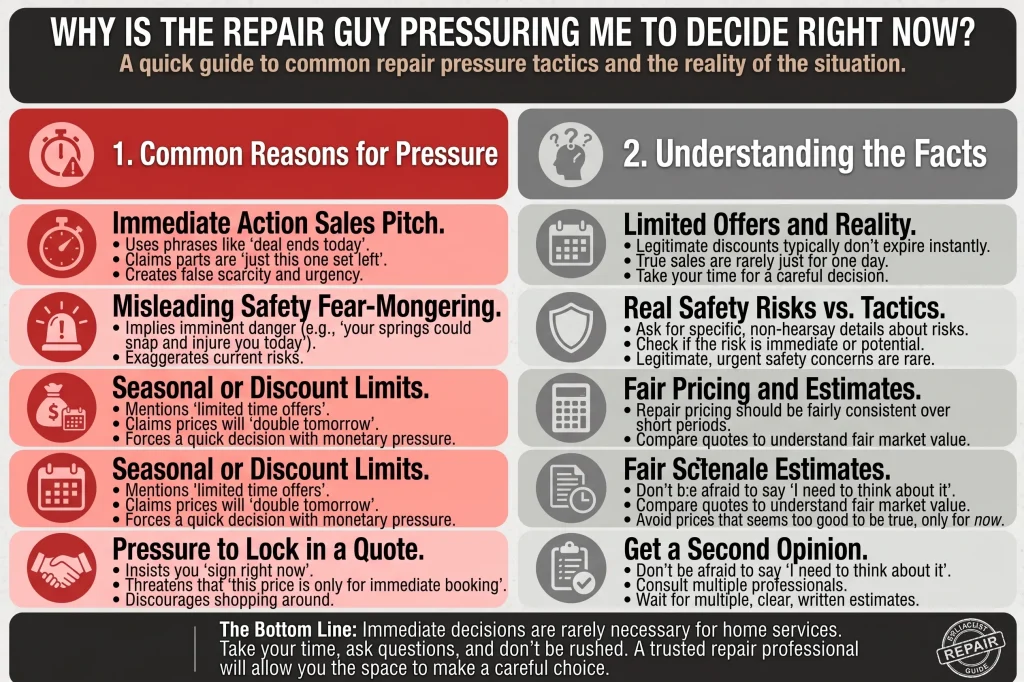
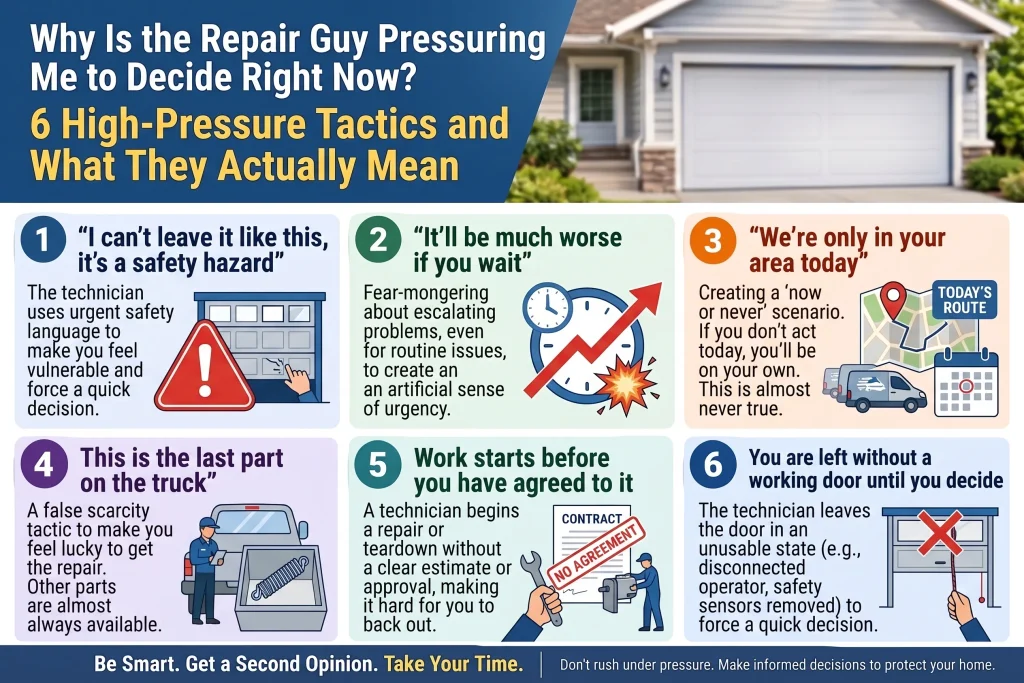
Because a decision made in three minutes is a decision made without a second opinion. That is the whole mechanism. Real urgency does exist on garage doors, and when it does, a technician will tell you plainly what the hazard is and then leave the decision with you. Manufactured urgency works differently: the deadline attaches to the visit rather than to the door. The crew is only here today. This is the last part on the truck. It will get much worse if you wait. The reliable test is to ask what specifically happens if you decide tomorrow. Genuine urgency names a consequence. Manufactured urgency changes the subject.
Key takeaways
- Urgency should come from the door’s condition, never from the schedule of the person standing in your driveway.
- Four conditions are genuinely same-day: a door stuck open on an unoccupied house, a door hanging crooked in the opening, a broken counterbalance holding weight overhead, and a door that will not stay closed.
- Everything else in garage door repair can wait until tomorrow, and waiting a day is the simplest protection you have.
- Ask one question: what specifically happens if I decide in the morning? A real answer names a consequence. A non-answer repeats the deadline.
- Pressure and scope grow together. The tactics on this page almost always arrive attached to a recommendation much larger than the problem you reported.
- You can end a visit at any point, and a company that treats no as negotiable has told you something more useful than its diagnosis did.
This piece expands one item from our larger guide, What Are the Most Common Garage Door Repair Scams? 10 Signs Homeowners Should Watch For, which covers the full pattern.
1. “I can’t leave it like this, it’s a safety hazard”
This is the most effective pressure line in the trade, because it is built on something true. Garage doors are heavy, springs store real energy, and there are genuine hazards on a failed door. That truth is exactly what makes the line so useful when the hazard is not real.
The difference is in the specificity. A real safety warning names a part, names a mechanism, and names a consequence: this cable is frayed at the drum, if it lets go the door drops on one side, keep the door closed until it is handled. A manufactured one stays general. The door is dangerous. Somebody could get hurt. You would not want your kids under this.
How to tell a real garage door safety warning from a pressure tactic
Ask what specifically is unsafe and what would have to happen for it to cause harm. Real hazards survive that question and get more specific. Manufactured ones get vaguer, or the subject moves to how much worse it could be.
Notice also who the warning is aimed at. Genuine warnings are aimed at the door and come with instructions: leave it closed, do not use the opener, do not put hands near the spring. Pressure warnings are aimed at your decision, and they tend to appear the moment you ask a question rather than at the moment the hazard was found.
The hazards that are real are worth knowing so you can recognize the rest. Our breakdown of the safety hazards actually associated with garage door work covers them, and what happens when a broken spring snaps explains the one hazard that genuinely deserves the alarm it gets. A torsion spring repair is a case where the safety language is usually legitimate, which is why it gets borrowed for everything else.
It is genuine urgency if: a specific part is named, the failure mechanism is explained, and you are given instructions for the door rather than a deadline for your decision.
2. “It’ll be much worse if you wait”
The second most common, and the vaguest. No timeline, no mechanism, no description of what worse looks like. Just the implication that delay converts a manageable situation into an expensive one.
Garage doors do have progressive failures. A misaligned track can wear rollers. A door out of balance works the opener harder. A dragging bottom section can take on moisture. Those are real, they are slow, and they are measured in months, not in the hours between now and tomorrow morning.
Will a garage door problem really get worse if I wait a day
Almost never in one day. That is the useful frame. Progressive damage on a door is a seasonal process, not an overnight one, so the question is not whether waiting is risky in general, but whether waiting until morning is. Ask it that way and the answer usually collapses.
Ask what changes between now and tomorrow. A real answer describes a mechanism: the door is out of balance so the opener is straining, the second cable is carrying the whole load, the top section is taking the weight. A non-answer restates the warning in bigger terms.
This tactic is most often attached to a replacement recommendation, because the larger the ask, the more pressure it needs. That combination is covered in Do I Really Need a New Garage Door, or Just a Repair? 6 Signs You’re Being Pushed Into a Replacement. Our guide on when a garage door repair genuinely prevents further damage covers the honest version, and how faulty movement signals a developing problem shows what real progression looks like.
It is genuine urgency if: the mechanism is named and it describes load being carried by something that was not designed to carry it.
3. “We’re only in your area today”
Geography as a deadline. The crew is finishing a job nearby, this is the only day they are on this side of town, and if you wait it becomes a scheduling problem.
For a company that actually works your area, this is not true, and it is easy to test. Ask when the next available appointment is. A company that serves Celina, Prosper, and the surrounding communities has trucks out here constantly, and the honest answer is tomorrow or the day after. A vague or evasive answer tells you the deadline was invented.
Why garage door companies say they are only in your area today
Because it makes the visit feel like a one-time opportunity rather than a normal service call, and because it discourages you from calling anyone else. Both effects work in the same direction: decide now, on the information in front of you, from the only person you are talking to.
There is a related version worth naming: the unsolicited visit. Someone is in the neighborhood, noticed your door, and is offering to take a look. That reverses the normal sequence, since you did not call anyone, and it is the pattern the door industry’s own homeowner resource on repair scam awareness flags most directly.
Availability pressure also gets applied to larger work, where a garage door replacement is presented as needing to be scheduled immediately to hold a slot. Scheduling is not a diagnosis, and no slot is worth committing to a decision you have not finished making.
It is genuine urgency if: you asked for same-day service yourself, or the door meets one of the four genuinely same-day conditions.
4. “This is the last part on the truck”
Scarcity applied to a component. The part is here now, it will not be next time, and the repair happens today or waits indefinitely.
Almost everything on a garage door is standard stock. Rollers, hinges, cables, brackets, sensors, and common springs are ordinary inventory that any working truck carries and any supplier restocks. A part being on the truck today is not a coincidence, it is the job. The scarcity is real only for genuinely unusual components, and those are not the parts this line normally gets used on.
Is a garage door part really unavailable if you wait
Rarely. If the part is standard, it will be on the next truck too, and a company that stocks it once stocks it routinely. Ask what the part is and whether it is a standard item. The answer separates a supply fact from a sales line quickly.
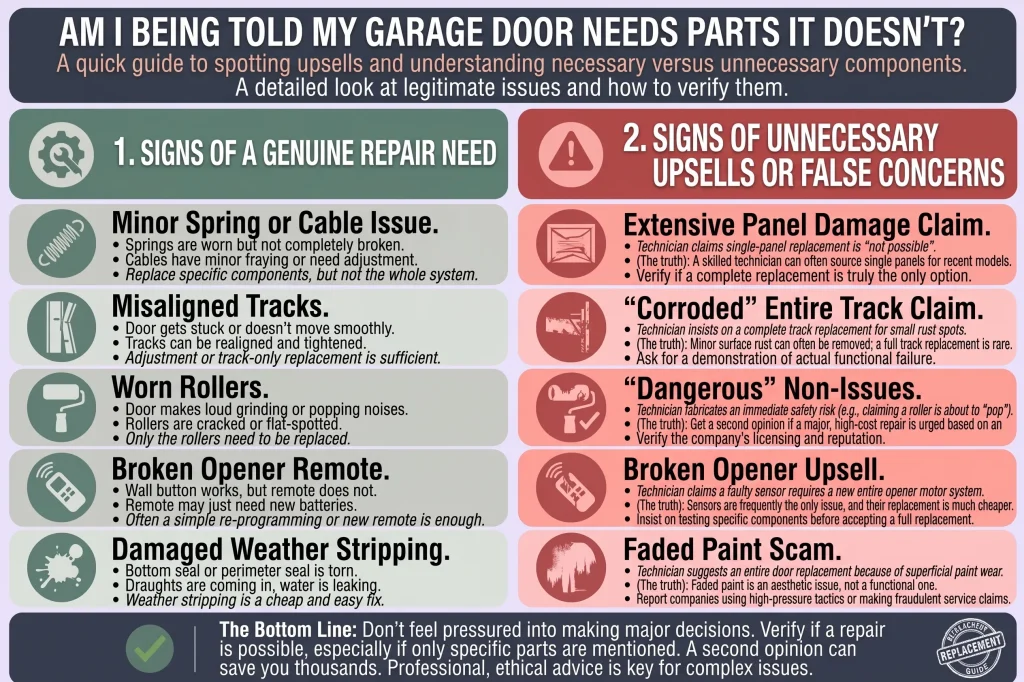
This tactic tends to travel with scope growth, because a longer parts list gives the scarcity argument more to work with. The parts side of that is covered in Am I Being Told My Garage Door Needs Parts It Doesn’t? 7 Unnecessary Part Replacements Homeowners Get Sold. Springs are the most common place this appears, and a torsion spring replacement uses springs matched to your door’s weight and dimensions, which is a specification question rather than a scarcity one. A manufacturer resource on recognizing garage door scams describes the same pattern.
It is genuine urgency if: the part is genuinely unusual for your door, you have been told which part and why, and you are offered a normal appointment as the alternative.
5. Work starts before you have agreed to it
The quietest tactic on this list, and the hardest to reverse. Nobody says anything pressuring. Panels come apart, hardware comes off, the opener gets disconnected, and by the time the recommendation is explained the door is already in pieces. Declining now means being left with a disassembled door.
This works by momentum rather than argument. It is much harder to say no to work already underway than to work being proposed, and the pressure comes from the situation rather than from anything said out loud.
What to do if a garage door technician starts work before you approve it
Say stop, plainly, and ask for the scope in writing before anything else comes apart. That is a normal request and it is the moment to make it. If the door is already partly disassembled, ask for it to be returned to a safe, closed state so you can think, and be clear that you are not authorizing anything further today.
Diagnosis is the exception worth understanding. Running the door, disconnecting the opener to check balance by hand, and inspecting the hardware are all part of finding the fault, and none of it commits you to anything. The line is between examining a door and beginning to rebuild one. Checking how a garage door opener responds is diagnosis. Removing its drive components is work.
We get called out to McKinney homes fairly often to finish or correct jobs that were started this way, and the pattern is consistent: the homeowner never actually said yes.
It is genuine urgency if: what is happening is diagnosis, meaning the door is being examined and run rather than taken apart.
6. You are left without a working door until you decide
The last tactic uses the door itself. The opener is disconnected, the door is left in a state you cannot operate, or you are told nothing can be done to make it usable in the meantime. Your car is inside, or your house is open, and the decision stops being about the repair.
Almost any door can be left in a safe interim condition. A door with a failed counterbalance can be left closed and secured. A door off track can be secured in place. A door with a dead opener can usually be operated manually once it is disconnected. Interim safety is a normal part of the job, not a favor.
Can a garage door be left secure while I get a second opinion
In most cases yes, and asking for exactly that is the right move. Say you want the door left in the safest condition possible while you take a day. A company doing straightforward work will do it without comment, because it takes minutes and it is standard practice.
One honest exception: a door with a broken spring should be left closed and should not be operated, and that is a real limitation rather than a lever. Our guides on whether a door with a broken spring can be opened and what not to do when a spring has failed explain why. The distinction is that a real limitation comes with an explanation and a safe interim state. A lever comes with neither.
If a door genuinely cannot be made usable and a full garage door installation is being recommended, that is exactly the situation that deserves a second opinion rather than an immediate decision, because it is the largest one you will be asked to make.
It is genuine urgency if: the door cannot be secured for a specific structural reason you have been shown, and the reason is explained rather than used.
Genuine urgency vs. manufactured urgency
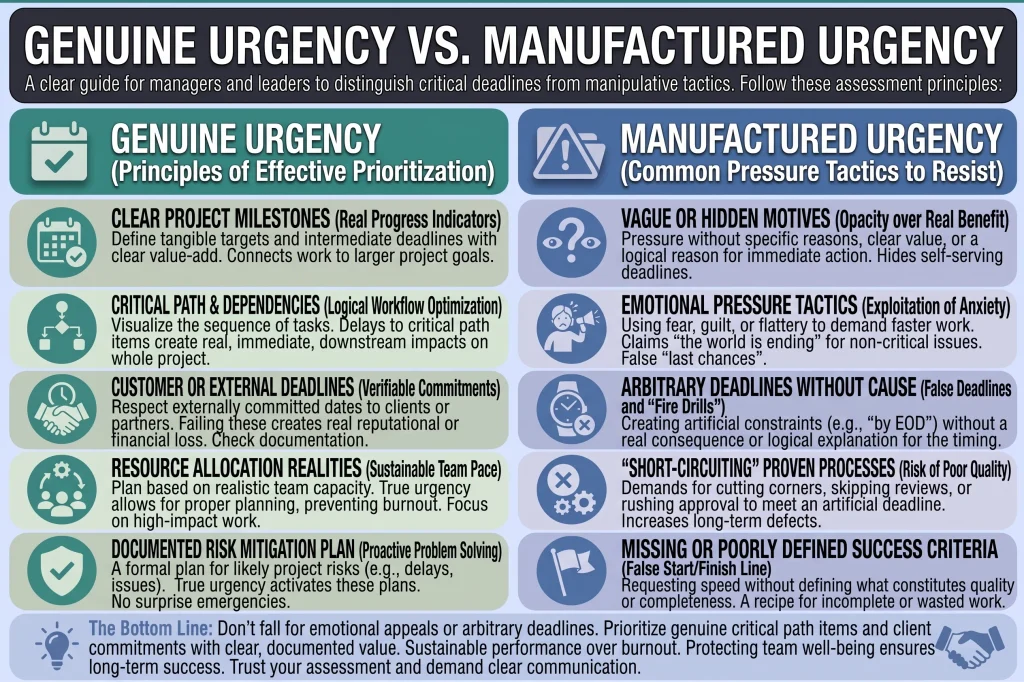
| Signal | Genuine urgency | Manufactured urgency |
| Source of the deadline | The door’s condition | The crew’s schedule or the truck’s inventory |
| Safety claims | Names the part, the mechanism, the consequence | Broad danger, no specifics, arrives after you ask questions |
| “It gets worse” | Describes a load path or a specific progression | No mechanism, no timeline, bigger words |
| Availability | You asked for same-day, or the door qualifies | Only in your area today, unsolicited visit |
| Parts | An unusual component, named, with a normal alternative offered | Standard hardware framed as scarce |
| Sequence of work | Door examined and run, then scope explained | Door disassembled, then scope explained |
| Interim state | Door left closed and secured while you decide | Door left unusable until you agree |
| Response to “tomorrow” | Fine, here is how to keep it safe overnight | Repeated deadline, escalation, or a new reason |
The short version
Four conditions are genuinely same-day: a door stuck open on a house nobody is watching, a door hanging crooked in the opening, a broken counterbalance holding weight overhead, and a door that will not stay closed. If yours is not one of those, you have until morning, and any recommendation large enough to feel pressured about is large enough to deserve a night.
The sentence that resolves almost every version of this is short: what specifically happens if I decide tomorrow? Ask it once and listen for whether you get a consequence or a deadline. Then, if you want a second look at the same door, take it. A real diagnosis will still be there in the morning, and the industry’s own association has publicly warned homeowners about pressure selling in the garage door trade for exactly this reason.
Alliance Overhead Door runs service calls across Celina, Aubrey, and the surrounding communities, and we are regularly the second opinion on a decision somebody was told to make on the spot. If you are being pushed to decide today, tell us what you were told and we will tell you what we find. If it can wait until morning, that is what you will hear.
Frequently asked questions
2. Is it rude to tell a technician I want to think about it overnight?
Not at all, and it is one of the most sensible things a homeowner can say. Our rule of thumb from the field is that any recommendation worth making is still worth making tomorrow. Nobody on our team has ever been inconvenienced by a customer taking an evening.
3. The technician says my door is dangerous. How do I know if that is true?
Ask what specifically is unsafe and what would have to happen for someone to get hurt. Real hazards get more specific under that question. If the answer stays at the level of the whole door being dangerous, you are hearing a general statement rather than a finding.
4. My car is stuck inside and I feel like I have to agree. What can I do?
Ask for the door to be released from the opener so it can be operated by hand, and get your vehicle out. On most doors that takes a minute. The exception is a door with a failed counterbalance, which should stay closed. Once your car is out, the time pressure mostly disappears, and that is the point.
5. Should I let someone who knocked on my door look at my garage door?
We would not. It reverses the normal order, since you did not call anyone. If you want it looked at, that is a good instinct to act on, but do it by calling a company you chose yourself rather than by accepting the visit at your door.
6. What if I say no and the technician keeps pushing?
Say it once, clearly, and stop explaining. Repeated justification just gives the conversation more to work with. If the pressure continues after that, end the visit. How someone responds to no is often more informative than the diagnosis they gave you.
7. The work has already started and now I am not sure. Can I stop it?
Yes. Ask for the door to be left in a safe, closed condition and be clear that nothing further is authorized. It is more awkward mid-job than beforehand, which is exactly why work sometimes starts early. Awkward is still better than agreeing to something you have not decided on.
8. How long does a real diagnosis take?
Several minutes at minimum. The door has to be run through its travel, listened to, disconnected from the opener so the balance can be felt by hand, and inspected at the springs, cables, tracks, and sensors. Anyone who delivered a conclusion before doing that has not diagnosed anything yet.
9. My door started acting up after a storm and I am told it is urgent. Is it?
Post-outage calls are one of our most common categories and they are usually not urgent. Tripped circuits, units that lost their programming, and sensors knocked out of alignment account for most of them. A door that still closes and stays closed can wait for a normal appointment.
10. If I get a second opinion, do I have to tell the second company what the first one said?
You do not, and there is an argument for holding it back at first. Let them look at the door and describe what they find on their own. Then compare. When two independent visits land on the same part and the same work, you can stop wondering. When they do not, you have learned the most useful thing available to you.