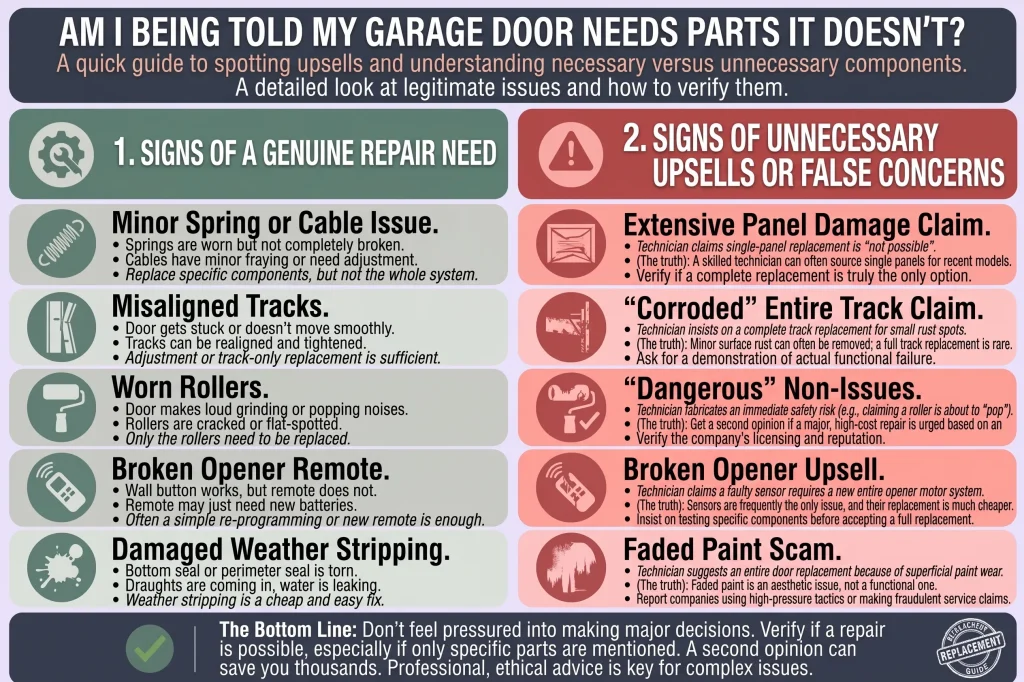
Probably, if the list grew after the door was examined and nobody showed you anything failing. Garage door parts wear in visible ways: rollers develop flat spots, cables fray into loose strands, springs show a clean gap in the coil, seals crack and stop touching the floor. Every one of those is something you can be walked to and shown. The seven replacements on this page are the ones most often added to a job without that demonstration, usually justified by age or bundled in while something else is being handled. The test is the same for all of them: ask to see the condition being described, on the part itself, before the work starts.
Key takeaways
- Wear is visible. If a part is worn enough to need replacing, you can be shown what that wear looks like.
- Age alone is not a diagnosis for any part on a garage door, and it is the most common justification for parts that did not need replacing.
- Rollers, cables, and seals are the three most commonly added items in garage door repair work, because they sound minor and they are easy to bundle.
- Openers are more modular than they look. Remotes, batteries, sensors, gears, and boards are separate serviceable pieces.
- Sensors get sold as failed when they are simply out of alignment, which is one of the quickest things to correct on the whole door.
- Some larger scopes are genuinely right. The difference is always whether a condition was demonstrated or simply asserted.
This piece expands one item from our larger guide, What Are the Most Common Garage Door Repair Scams? 10 Signs Homeowners Should Watch For, which covers the whole pattern.

1. A full set of rollers when only a few are worn, or none are
Rollers are the most commonly added part on a garage door, and it is easy to see why. There are ten or more of them, they are small, they genuinely do wear, and replacing all of them sounds like ordinary maintenance rather than a decision.
Rollers wear unevenly. The ones carrying the most load and taking the most travel go first, which usually means the bottom and second-section rollers. A door with a few worn rollers is not a door needing a full set, and plenty of noisy doors have rollers that are simply dry rather than worn.
How to tell if your garage door rollers actually need replacing
Worn rollers show it. Look for flat spots on the wheel, visible play where the stem meets the wheel, a wheel that will not spin freely by hand, or a stem that is scored. Ask to be shown those conditions on the specific rollers being replaced, not on rollers in general.
Noise is the usual entry point for this one, and noise is frequently a service condition rather than a failure. A dry roller and a worn roller sound similar to a homeowner and look nothing alike up close. We see this often on doors around Celina and Prosper that cycle heavily and have simply never been serviced. The door industry’s scam awareness guidance for homeowners describes bundled minor parts as a recurring pattern for exactly this reason.
It is genuinely necessary if: you have been shown flat spots, play, or scoring on the specific rollers in question, or the door has enough cycles on it that a full set is a reasonable planned replacement you chose.
2. Both springs, or heavier-duty springs, when the door does not need them
Two separate things get sold here, and only one of them is usually questionable.
Replacing both springs when one has broken is normally reasonable. Paired springs run identical cycle counts, so when one reaches the end the other is close behind, and handling both at once is a sensible call. That is a cycle-life decision and it should be explained as one.
The second version is different: heavier-duty springs presented as necessary rather than as an option. Higher cycle-rated springs are a real product and they make sense on doors that run many times a day, but they are an upgrade chosen for a usage pattern, not a correction for a fault. Presenting them as required is where this crosses over.
Do I need to replace both garage door springs or just the broken one
If both springs have run the same cycles, doing both is the practical choice, and most homeowners are better served by it. What should not happen is that decision being framed as two failures when only one part actually broke. A torsion spring repair on a paired system is a conversation about cycle life, and you are entitled to have it explained that way.
For the upgrade question, the honest test is your own usage. Our guides on how long garage door springs actually last and what sets high-cycle springs apart cover where heavier-rated springs earn their place, and how often springs break puts the timeline in context.
The safety point here is real and not negotiable: nobody without training should put hands on a torsion spring, the shaft, or the cables while the system is under tension. Stored energy in a wound spring is the one hazard on a garage door that fully deserves its reputation.
It is genuinely necessary if: both springs have comparable cycle counts, or you run the door frequently enough that a higher cycle rating is a choice you made deliberately.
3. The whole opener when a component failed
An opener is not one part. It is a motor, a gear assembly, a logic board, a receiver, sensors, a wall control, remotes, and in many cases a battery. Any one of those can fail while the rest of the unit is fine, and the failures that bring people to call are usually in the small, replaceable pieces.
The pattern to watch is the jump from a specific symptom to the whole unit. The door does not respond, or responds intermittently, or the light flashes, and the recommendation is a new garage door opener rather than a diagnosis of which component is at fault.
Does my garage door opener need replacing or just a part
Ask which component failed. A real diagnosis names one: the gear assembly is stripped, the board is not sending the signal, the receiver is not seeing the remote, the travel limits have drifted. Each of those is a serviceable item on most units.
Start with the simplest possibilities being ruled out, because they account for a large share of these calls: a dead remote battery, a backup battery at the end of its life, a tripped circuit, a unit that lost its programming, or travel and force settings that need adjusting. Our guides on replacing an opener battery and how to adjust a garage door opener cover the ordinary version of these symptoms, and a manufacturer guide to spotting garage door repair scams addresses the whole-unit jump directly.
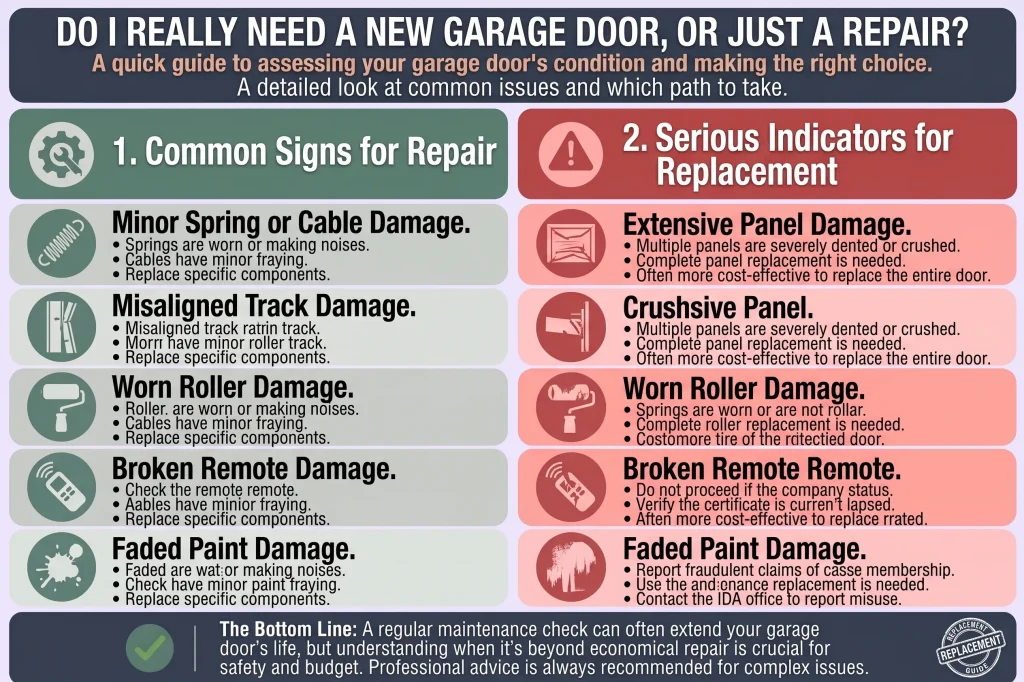
When the recommendation escalates past the opener to the door itself, you have moved into the territory covered in Do I Really Need a New Garage Door, or Just a Repair? 6 Signs You’re Being Pushed Into a Replacement.
It is genuinely necessary if: a named component failed and it is not separately serviceable on your unit, or the unit is old enough that parts support has genuinely ended and you were told which part.
4. Safety sensors that only needed realigning
The photo eyes near the floor on each side of the opening are among the most misdiagnosed parts on a garage door. When they are not seeing each other, the door refuses to close, or closes part way and reverses, and the symptom looks like a failure.
Most of the time they are simply out of alignment. They get bumped by a bicycle, a trash can, a vehicle door, or a broom. Sunlight at a low angle can interfere with them. A loose bracket lets one drift over months. All of those produce the same symptom as a failed sensor and none of them requires a new part.
Why won’t my garage door close when the sensors look fine
Because looking fine and being aligned are different things. The sensors have to be pointed at each other within a small tolerance, and a few degrees of drift is invisible from standing height. Most units indicate alignment with a small light on the sensor housing, which is the first thing that should be checked.
The other common cause is even simpler: something in the beam path that nobody noticed. A leaf, a stored item, or a cable resting across the opening will produce the identical symptom.
A door that reverses before closing gets read as a sensor problem when it is sometimes a travel or force setting instead, or a track condition making the door bind on its way down. This is one of the more frequent McKinney calls we take, and most of them end with an alignment and a cleaning rather than a part.
It is genuinely necessary if: the sensor has physical damage, a cut or damaged wire, or it will not indicate correctly after alignment has been confirmed.
5. Cables replaced as a matter of routine
Cables get added to spring work almost automatically, and there is a defensible reason for it: they run the same cycles as the springs, they carry the door’s weight, and a cable failure while the door is in motion is genuinely bad. Replacing them alongside springs on a high-cycle door is often sound practice.
What makes it questionable is when it happens without any inspection and without explanation, on a door where the cables are visibly in good condition. Routine is not the same as necessary, and the difference should be stated rather than assumed.
How can I tell if my garage door cables need replacing
Cables fail visibly and progressively. Look for broken strands standing out from the twist, kinks, flattened sections, rust and pitting, or fraying concentrated at the bottom bracket or where the cable wraps the drum. A cable in that condition should be replaced. A cable that is smooth, tight, and clean is doing its job.
Ask specifically whether the cables were inspected and what was found. On a torsion spring replacement covering a door with many years of cycles, including the cables is a reasonable recommendation and worth accepting. On a newer door with a single broken spring, it should be justified rather than included silently.
It is genuinely necessary if: you have been shown fraying, kinking, or corrosion, or the cables have run the same long cycle life as springs being replaced and that reasoning was explained.
6. Full track replacement for a localized bend
A bent track is a real condition with real consequences, and it also gets scoped much larger than it needs to be. A door that binds, jumps, or grinds at one point in its travel often has one damaged area, not a failed track system.
Tracks come in sections, and vertical and horizontal portions are separate. Localized damage from a vehicle bump or an impact is frequently addressed by correcting or replacing the affected portion and realigning the rest. Whole-system replacement is a genuine need when damage runs through multiple areas or the track has been compromised along its length.
Can a bent garage door track be fixed without replacing all of it
In many cases yes, depending on where the damage is and how severe it is. What matters is whether the track can be brought back to a true, consistent channel. Minor bends in accessible areas are often correctable. Crushed or twisted sections generally need that section replaced.
The related question is whether the door itself survived, because a track problem and a section problem often arrive together after an impact. Our guides on what causes a bent garage door track, why a bent track is dangerous, and what happens when a bent track is ignored cover the real risks, which are worth understanding so you can tell when the alarm is justified. If the recommendation moves from the track to a garage door replacement, ask what specifically about the sections or the frame drove that change.
It is genuinely necessary if: damage extends through multiple portions of the track, or a section is crushed or twisted badly enough that it cannot be returned to a true channel.
7. Weather seals, hinges, and small hardware bundled onto every job
The last one is the smallest and the most common. A bottom seal, a set of hinges, bearings, or brackets appear on the work being described, usually near the end, usually without much comment. Individually each is minor. Together they can add up to a meaningful share of the job.
Some of this is legitimate. A cracked bottom seal that no longer contacts the floor should be replaced, worn hinges do develop play, and a failed bearing is audible and worth handling. The issue is inclusion without demonstration, particularly when the items arrive as a group rather than as findings.
Do I need a new garage door bottom seal and hinges
Only if they are failing, and both show it plainly. A bottom seal that has hardened, split, or pulled away leaves a visible gap along the floor, and you can see daylight under a closed door. Worn hinges have visible play at the pin and often show elongated holes. Ask to be walked along the door and shown what is being described.
Seals in particular are worth understanding because they genuinely do wear out here, and our guide on installing garage door weather stripping covers what a failed one looks like. A worn seal is a real item. A seal added to every job regardless of condition is a different thing.
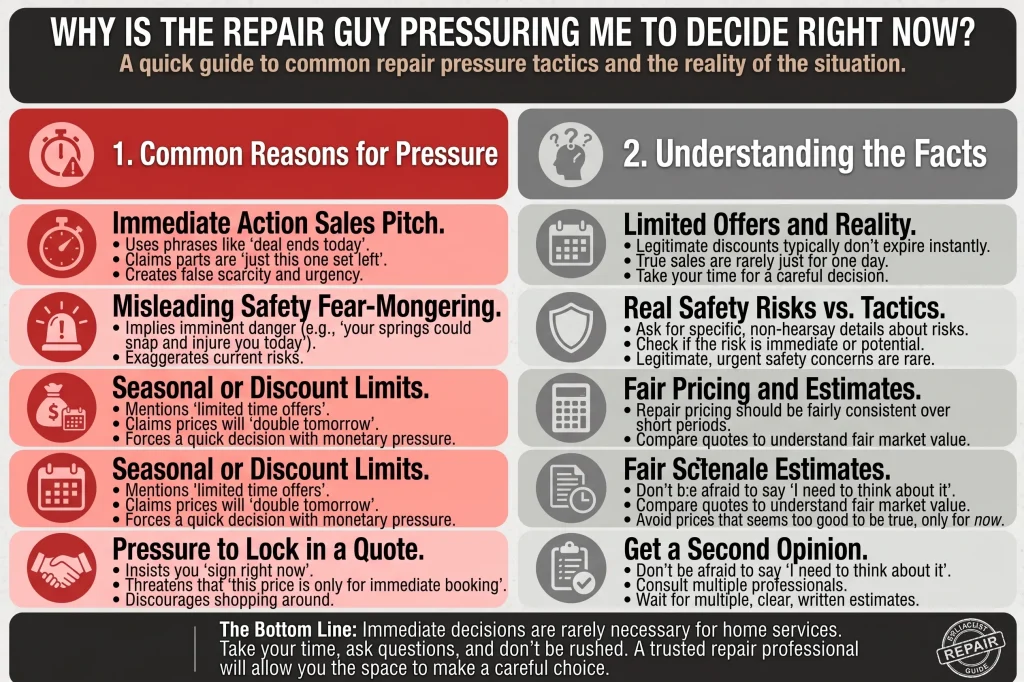
When a bundle of small items arrives alongside a deadline for deciding, you are seeing two techniques together, and the timing side is covered in Why Is the Repair Guy Pressuring Me to Decide Right Now? 6 High-Pressure Tactics and What They Actually Mean. The industry association has publicly flagged scope inflation on repair calls as a growing concern.
It is genuinely necessary if: you have been shown the specific condition on each item, or you asked for the work as planned maintenance.
Which parts genuinely need replacing

| Part | Genuinely needs replacing when | Probably does not when |
| Rollers | Flat spots, stem play, scoring, wheels that will not turn | Door is only noisy, or rollers are dry rather than worn |
| Springs | One has reached the end of its cycle life, or both have run the same cycles | The door is sound and heavier-rated springs are being framed as required |
| Opener | A named component failed and is not separately serviceable | Symptom traces to a remote, battery, circuit, programming, or settings |
| Sensors | Physical damage, damaged wiring, or will not indicate after alignment | Alignment, an obstruction in the beam, or sunlight interference |
| Cables | Broken strands, kinks, flattening, rust or pitting | Smooth, tight, clean cables on a newer door with no inspection cited |
| Track | Damage through multiple portions, crushed or twisted beyond truing | One localized bend that can be corrected or replaced in part |
| Seals and hardware | Visible gap at the floor, split seal, play at hinge pins | Bundled onto the job without any condition demonstrated |
The short version
Every part on this list fails in a way you can see. That is what makes the check so reliable: you do not need to know how a garage door works to ask someone to point at the flat spot, the frayed strand, the gap under the door, or the light on the sensor housing. If the condition is there, you will see it. If it is not, the request quietly ends the conversation.
Ask before the work starts, not after, and ask about each item rather than the list as a whole. Then keep the old parts. A removed part either shows the failure you were told about or it does not, and that is the one piece of verification that survives the visit.
Alliance Overhead Door services doors across Celina, Aubrey, and the surrounding communities, and second opinions on someone else’s parts list are a routine part of our week. If you have been handed a list that seems longer than the problem you called about, send us what you were told and we will tell you what we find. If the parts are genuinely worn, you will hear that too, and if what you actually need is a planned garage door installation rather than a repair, we will say so plainly.
Frequently asked questions
2. Only one spring broke. Why am I being told to replace both?
That one is usually legitimate. Paired springs run the same cycles, so when one reaches the end the other is generally close, and doing both at once saves you a second visit. What should not happen is it being described as two failures. One broke. The other is a cycle-life decision.
3. Do I need heavy-duty springs?
Only if you run the door a lot. On a household cycling it a few times a day, standard springs are appropriate. On a door that is the main entrance to the house and runs ten or more times a day, a higher cycle rating is worth considering. It is a usage decision, not a repair.
4. My opener is twelve years old and I was told it is not worth servicing. True?
Not automatically. Plenty of units that age are perfectly serviceable, and we replace boards, gears, and sensors on older openers regularly. What would make it true is a specific part that genuinely is no longer supported, and if that is the reason you should be told which one.
5. My door will not close and the sensors look fine. What now?
Check the small indicator light on each sensor housing, and look for anything in the beam path. Alignment drift of a few degrees is invisible from standing height but stops the door cold. This is one of the quickest things on the whole door to correct, and it very often turns out to be the whole problem.
6. Should cables be replaced every time springs are?
On a door with many years of cycles, including them is sound practice and we usually recommend it. On a newer door with one broken spring, it should be explained rather than assumed. The deciding factor is condition and cycle history, and cables show their wear clearly enough that you can be shown either way.
7. How do I know if my garage door track is bent badly enough to replace?
Watch where the door struggles. Binding or grinding at one consistent point suggests localized damage. Trouble throughout the travel points to something broader. Either way, ask which portion of the track is affected, because vertical and horizontal sections are separate and one does not condemn the other.
8. Is a new bottom seal something I actually need?
If you can see daylight under the closed door, or the seal has split, hardened, or pulled away, yes. They do wear out in this climate. What we would question is a seal appearing on every job as a matter of routine without anyone looking at the one you have.
9. What should I ask before agreeing to a parts list?
Two questions, one at a time, for each item: can you show me the condition, and what happens if we address only what actually failed. Our rule of thumb from the field is that anything we recommend, we can point at. Items that cannot be pointed at are the ones to set aside.
10. Can I keep the parts that get removed?
Yes, and we would encourage asking for them. It is routine, it takes no effort, and it gives you the only verification that outlasts the visit. A part that was replaced for being worn shows that wear in your hand.