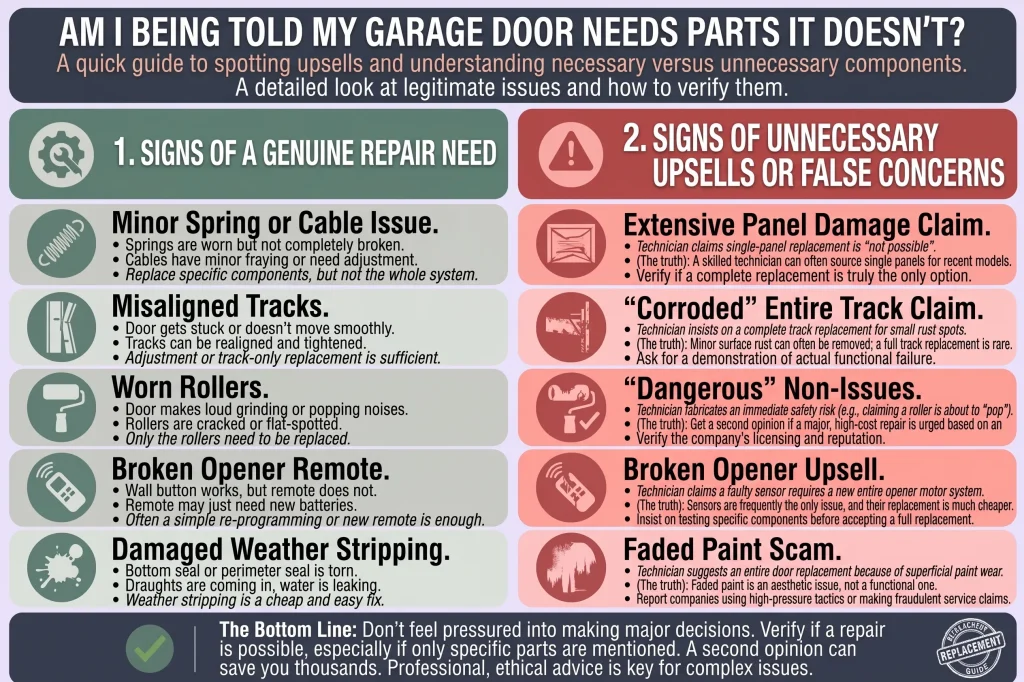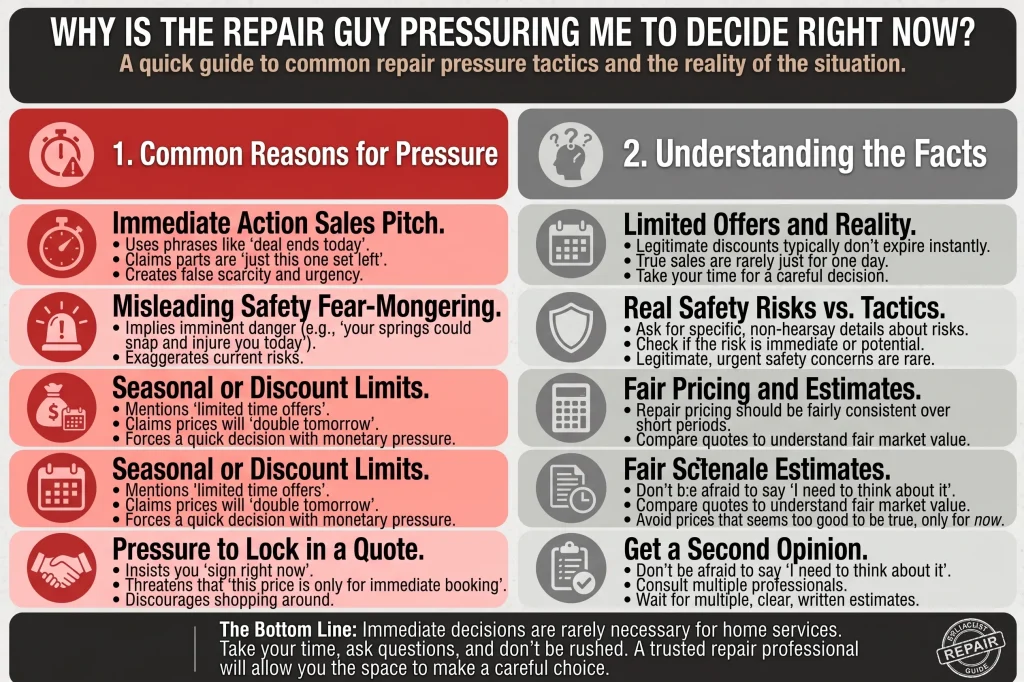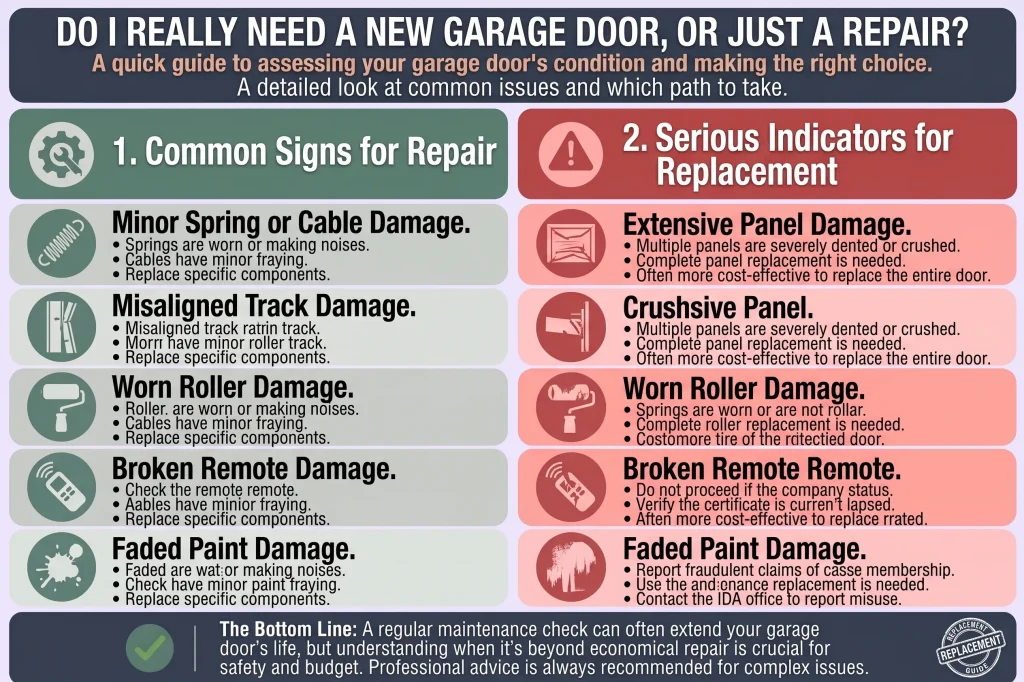
Most garage doors that get replaced did not need to be. A door is a system of separate parts, and nearly every common failure lives in one of them: a spring, a cable, a roller, a hinge, a section, a sensor. Replacing the whole door because one part failed is the single most common overreach in this trade. You are likely being pushed into a replacement when the recommendation covers far more than the symptom you reported, when age is the main reason given, or when the conversation drifts from what broke to what a new door would look like. The check is simple: ask which specific part failed, and ask what happens if only that part is addressed.
Key takeaways
- One damaged section is a section problem. A door with a straight frame, quiet travel, and one bad panel is a garage door repair situation.
- Age by itself is not a diagnosis. Plenty of twenty-year-old doors are mechanically sound, and plenty of eight-year-old doors are not.
- Springs and cables are wear parts. They are expected to fail eventually, and their failure says nothing about the door itself.
- A door off its track looks catastrophic and usually is not. It is one of the most misread conditions in the trade.
- When the conversation shifts from what broke to insulation, appearance, or features, the diagnosis is finished and the selling has started.
- Replacement is genuinely right for some doors. It should be justified by the door’s condition, not by the age on the label or the urgency in the room.
This piece expands one item from our larger guide, What Are the Most Common Garage Door Repair Scams? 10 Signs Homeowners Should Watch For, which covers the whole pattern.

1. One damaged section turns into a recommendation to replace the whole door
This is the most frequent version by a wide margin. A vehicle taps the bottom section. A storm dents one panel. The door still opens, closes, and tracks properly, and the recommendation that comes back is a new door.
Sectional doors are built in separate horizontal sections joined by hinges, and that construction exists precisely so one section can come off without the rest of the door coming down with it. A single damaged section on an otherwise square, quiet door is a section replacement.
How to tell if you need a full garage door replacement or just one panel replaced
Look at three things: how many sections are affected, whether the door still runs straight through its travel, and whether the frame and tracks are still true. Damage confined to one section, on a door that runs smoothly and sits square in the opening, points to a section swap. Damage across several sections, or a door that binds and scrapes as it travels because the structure is no longer straight, is a different conversation.
Availability is the one real complication. Matching a section to an older door is not always possible, and when it is not, that is a legitimate reason a garage door replacement enters the picture. But that has to be stated as what it is, a matching problem, and not presented as a structural failure. Our guides on how garage door panels work and when they need replacing and whether full panel replacement is actually necessary lay out where that line sits, and what causes panel damage over time explains why the damage tends to concentrate in the lower sections.
We see this often on newer builds around Celina and Prosper, where a door is only a few years old and has one dented section from a bumper.
Replacement is genuinely the answer if: multiple sections are damaged, the door no longer sits square in the opening, or a matching section for your door is genuinely unavailable and you have been told so plainly.
2. The age of the door is the main reason given
You reported a specific problem. The answer comes back centered on the number: the door is fifteen years old, doors last about that long, so it is time.
Age is a useful piece of context and a poor diagnosis. Garage doors age unevenly depending on how many times a day they run, how they were installed, and whether they were ever maintained. A door on a house where it cycles four times a day for twenty years can be in better mechanical shape than one that cycles fifteen times a day for eight.
Why the age of your garage door is not a reason to replace it
Because age predicts nothing you cannot check directly. What matters is condition: are the sections straight and solid, does the door travel without binding, is the counterbalance still holding the door where you leave it, are the tracks true, is the frame square. Those are observable. If the answers are good, the door is fine regardless of its birthday.
Ask which specific condition the age is standing in for. A real answer names something: sections are separating at the joints, the bottom section has taken on moisture and is failing, hardware is worn across the whole door. A non-answer just repeats the number. The signs that genuinely point to replacing an older door covers the conditions that actually count, and the door industry’s own scam awareness resource for homeowners describes the age argument as a familiar sales pattern.
Replacement is genuinely the answer if: the age is attached to a specific observable condition, and you have been shown that condition.
3. A broken spring or cable becomes a new door
This one catches people because the failure sounds so severe. A spring lets go with a bang like a gunshot, the door will not lift, and the whole assembly feels compromised. Then the recommendation arrives: while we are in here, you may as well replace the door.
Springs and cables are wear items. They have a working life measured in cycles, and they are expected to reach the end of it. A failed spring is the system doing exactly what it was designed to do, in the part designed to take that stress. It tells you nothing about the sections, the tracks, or the frame. A torsion spring repair on a sound door restores it to normal service.
Does a broken torsion spring mean I need a new garage door
No. A broken spring means you need a spring. The one honest complication is that springs come in pairs on many doors, and when one has reached the end of its cycle life the other is usually close behind, so a torsion spring replacement covering both is often the sensible call. That is a decision about two springs. It is not a decision about the door.
Watch for the jump in scope here, because it is the same move covered in Am I Being Told My Garage Door Needs Parts It Doesn’t? 7 Unnecessary Part Replacements Homeowners Get Sold. Our guide on when a broken torsion spring should be replaced covers what the repair actually involves.
One safety note, and it is the real one on this page: do not put hands on a torsion spring, the shaft, or the cables while the system is under tension. That is not a scare tactic. Stored energy in a wound spring is genuinely dangerous, and the correct response to a broken spring is to leave the door closed and have someone qualified handle it.
Replacement is genuinely the answer if: the spring failure was violent enough to damage the sections, brackets, or top fixture, and you have been shown that damage.
4. A door off its track becomes a total loss
A door hanging out of its tracks looks like the end of the door. It sits crooked in the opening, panels are skewed, rollers are out of the channel, and it is genuinely unsafe to operate in that state. It is also, in most cases, a recoverable condition.
Doors come off track for identifiable reasons: an obstruction under the door, a broken cable letting one side drop, a hit from a vehicle, worn rollers, or a track that has been knocked out of alignment. Each of those is a specific fault with a specific correction. The dramatic appearance is a symptom, not a verdict.
Can a garage door that came off its track be repaired instead of replaced
Usually yes. What determines it is whether the sections and the track survived. Rollers back in the channel, a realigned or replaced track section, and a new cable will return most off-track doors to normal service. What pushes it toward replacement is structural: sections bent or creased along their length, hinges torn from the material, or a frame knocked out of square.
The distinction matters because this is the condition where urgency is most persuasive. The door is visibly wrong and you want it resolved today, which is a poor moment to be evaluating a large recommendation. Our guides on how to address a garage door that is off track and whether a bent track can be repaired cover what is recoverable. This is one of our more common McKinney service calls, and the majority of them do not end in a new door.
Replacement is genuinely the answer if: sections are creased or bent through their structure, hardware has torn out of the material, or the frame is no longer square.
5. You are told parts for your door are no longer available
This one is difficult to argue with, which is exactly why it works. If the part does not exist, the repair is impossible, and the only path forward is a new door. The claim ends the conversation before it starts.
Sometimes it is true. Older doors and discontinued product lines do reach a point where matching sections or specific hardware cannot be sourced. But the claim is also easy to make and rarely checked, and it gets applied to parts that are in fact standard. Rollers, hinges, cables, springs, brackets, and track are largely built to common specifications. It is generally the cosmetic and structural pieces, matching sections and particular panel designs, where availability genuinely runs out.
What to do when you are told garage door parts are discontinued
Ask which specific part is unavailable and why. Then ask whether a functional equivalent exists even if an exact visual match does not, because those are two different problems and they get deliberately blurred. A section that no longer matches your door’s design is a cosmetic limitation. A door that cannot be made to run safely is a functional one.
The same claim shows up around openers, usually as a unit being too old to service. Openers are more modular than they look, and remotes, sensors, gears, boards, and drive components are commonly available for a garage door opener still in production territory. Our overview of the parts that make up a garage door opener shows how separable those pieces are. A manufacturer buying guide on avoiding garage door scams covers the same availability claim from the industry side.
Replacement is genuinely the answer if: a specific named part is unavailable, you have been told which one, and no functional equivalent exists.
6. The conversation moves from what broke to what a new door would offer
Watch for the moment the subject changes. You called about a noise, a sag, or a door that stopped part way. Somewhere in the visit the topic becomes insulation, curb appeal, quieter operation, or added features. Nobody has told you the original problem cannot be addressed. The problem simply stopped being the topic.
This is the most polite version of the push, and the hardest to object to, because everything being said is true. A new door often is better insulated and quieter and better looking. None of that answers the question you asked, which was what is wrong with the door I have.
How to tell the difference between a garage door repair recommendation and a sales pitch
Bring it back to the fault. Ask directly: can the problem I called about be addressed on this door, yes or no. If the answer is yes, then everything after that is a separate decision you can make on your own schedule. If the answer is no, ask what specifically prevents it.
There is nothing wrong with wanting a better door, and a planned garage door installation chosen deliberately is a good outcome. Our guides on the best materials for a new garage door and what makes a garage door energy efficient are worth reading when you decide to have that conversation. The difference is whether you chose it or whether it arrived attached to a repair call. The industry association has publicly raised concerns about how repair calls get converted into replacement sales, which is the pattern in plain terms.
When feature talk arrives with a deadline on it, you are seeing two techniques at once. The timing side is covered in Why Is the Repair Guy Pressuring Me to Decide Right Now? 6 High-Pressure Tactics and What They Actually Mean.
Replacement is genuinely the answer if: you decided you wanted a better door on your own terms, with the original fault answered separately.
Repair territory vs. replacement territory
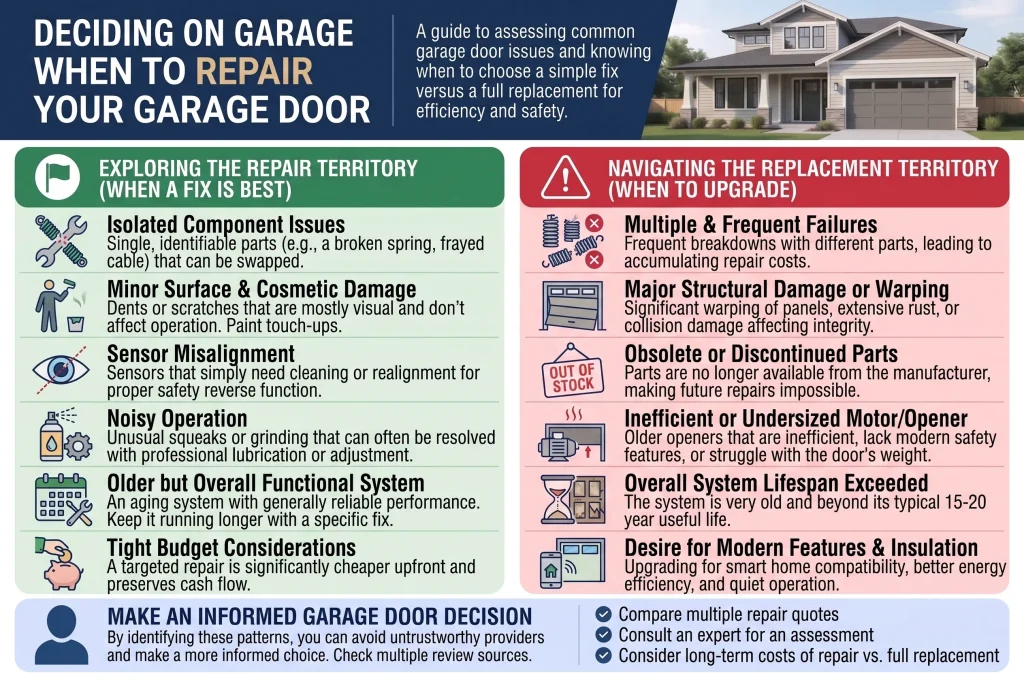
| Condition | Usually a repair | Usually a replacement |
| Damaged sections | One section, door still square and running true | Several sections, or structure no longer straight |
| Age of the door | Sound sections, smooth travel, holding balance | Sections separating or failing across the door |
| Spring or cable failure | The wear part failed and the door is otherwise sound | The failure damaged sections, brackets, or fixtures |
| Off-track door | Rollers, cable, or track alignment at fault | Sections creased through, hardware torn out, frame out of square |
| Part availability | Standard hardware: rollers, hinges, cables, springs, track | A specific section or design that cannot be matched or substituted |
| Opener trouble | Remotes, sensors, gears, boards, drive components | Unit genuinely beyond serviceable support |
| Reason given | A named part and an observable condition | A named part and an observable condition |
| Reason not accepted | Age alone, vague wear, or feature talk | Age alone, vague wear, or feature talk |
The short version
The question is not whether your door is old. It is whether the specific thing that failed can be addressed on the door you have. That question has a factual answer, and anyone who has examined the door can give it to you in one sentence naming one part.
Ask it plainly, and ask what happens if only that part is handled. If you get a specific answer with a condition you can see, you have a real recommendation, whichever way it points. If you get age, generalities, or a tour of what a new door would be like, you have something else, and you are entitled to take a day and get a second look at the same door.
Alliance Overhead Door works on doors across Celina, Aubrey, and the surrounding communities, and a fair number of our calls are second opinions on doors somebody else recommended replacing. If you have been told your door needs to go and it does not feel right, send us what you were told and we will tell you what we find. If the door can be repaired, that is what you will hear.
Frequently asked questions
2. How old is too old for a garage door?
There is no number, and anyone who gives you one is guessing. We service doors well past twenty years that are mechanically sound and we replace doors much younger than that because the sections have gone. Our rule of thumb from the field is that condition decides it: how the door travels, whether it holds its balance, and whether the sections are still solid.
3. My spring broke and I was told the door should be replaced. Should it?
Almost never on that basis alone. A spring is a wear part reaching the end of its cycle life, and its failure is not evidence against the door. The exception is when the failure did collateral damage on the way out, and if that is the claim, ask to be shown the damaged bracket or section.
4. Both my springs are being replaced but only one broke. Is that necessary?
Usually reasonable, and this is one of the few times a larger scope is legitimate. Paired springs run the same number of cycles, so when one reaches the end the other is generally close. That said, it should be explained as a cycle-life decision, not presented as a second failure that already happened.
5. My door came off the track. Is it ruined?
Rarely. It looks alarming and it should not be operated in that state, but most off-track doors go back into service once the underlying cause is corrected. What changes the answer is structural damage to the sections themselves. Leave it alone until someone can look at it, because trying to force it back can turn a repairable door into a real problem.
6. I was told parts for my door are discontinued. How do I check that?
Ask which exact part, and ask whether a functional substitute exists even if an exact match does not. Standard hardware is rarely truly unavailable. Matching a specific section or design on an older door genuinely can be, and that is the honest version of this answer.
7. Would a new door lower my energy use?
An insulated door can make a meaningful difference in an attached or conditioned garage, especially here in the Texas heat. But that is a separate question from whether your current door is broken, and it should not be the answer to a repair call. If efficiency is what you are after, plan for it on its own.
8. Should I get a second opinion before agreeing to a replacement?
Yes, and for something this size we would say the same about our own recommendation. A real diagnosis gets found twice. If two independent visits identify the same failure and reach the same conclusion, you can proceed with confidence. If they disagree completely, that disagreement is the most useful information you have.
9. My door is noisy and slow. Does that mean it is wearing out?
Usually it means it needs attention, not replacement. Noise and sluggish travel most often trace to dry or worn rollers, loose hardware, or an out-of-adjustment opener. Those are among our most common calls and they are ordinary corrections on a sound door.
10. If I decline a replacement, will the technician still fix the actual problem?
That is exactly the question to ask, and the answer tells you a great deal. A company doing repair work will address the fault you called about. If declining the larger recommendation means the original problem suddenly cannot be handled at all, you have learned what the visit was really for.