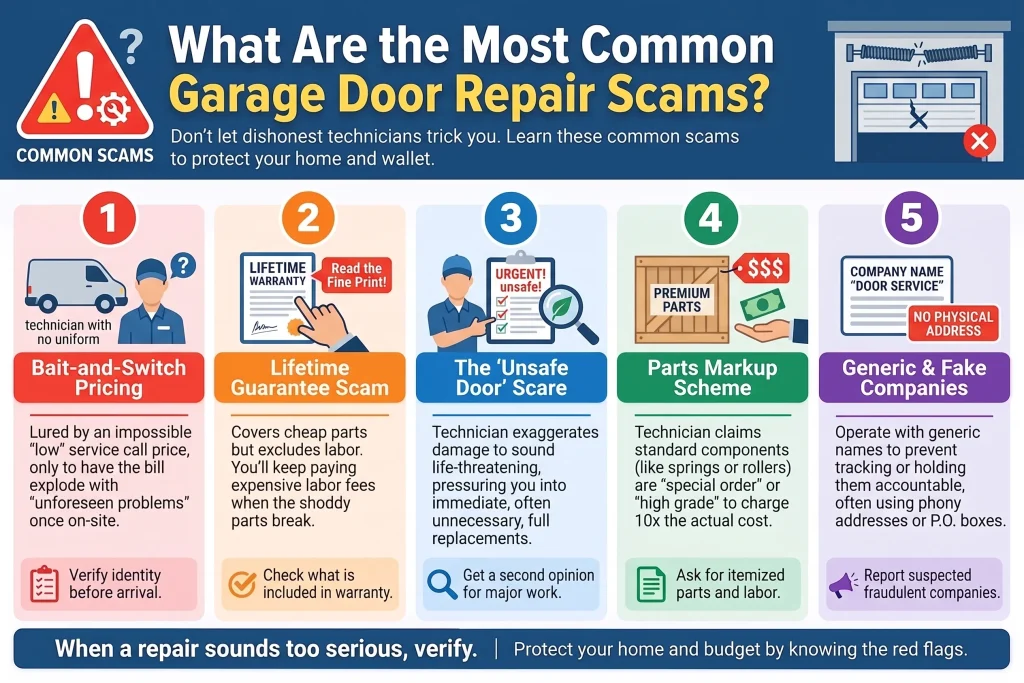
Most garage door repair scams are not complicated. They come down to one pattern: a small, ordinary failure gets presented as a large, urgent one. A single worn roller becomes a full door replacement. A dead remote battery becomes a new opener. The most reliable signs of a scam are behavioral, not technical. The work is sold before the door is examined, you are pushed to decide in the next few minutes, parts appear on the job that nobody showed you failing, and nothing is put in writing. If you can slow the visit down and ask to see the failed part, most of these attempts fall apart on the spot.
Key takeaways
- A garage door has a handful of parts that commonly fail. When someone tells you nearly all of them failed at once, treat that as the first red flag.
- Urgency is the tool, not the problem. Legitimate garage door repair work still gets done tomorrow if you need a day to think.
- Ask to see the failed part and hear what it does. An honest technician will walk you to it. A dishonest one will change the subject.
- Whole-unit replacement for a single failed component is the most common overreach we see, and it is also the easiest to check.
- Nothing should start before the scope of work exists in writing, in plain language, naming the specific part.
- You are allowed to end a visit, keep your old parts, and have a second company look at the same door.
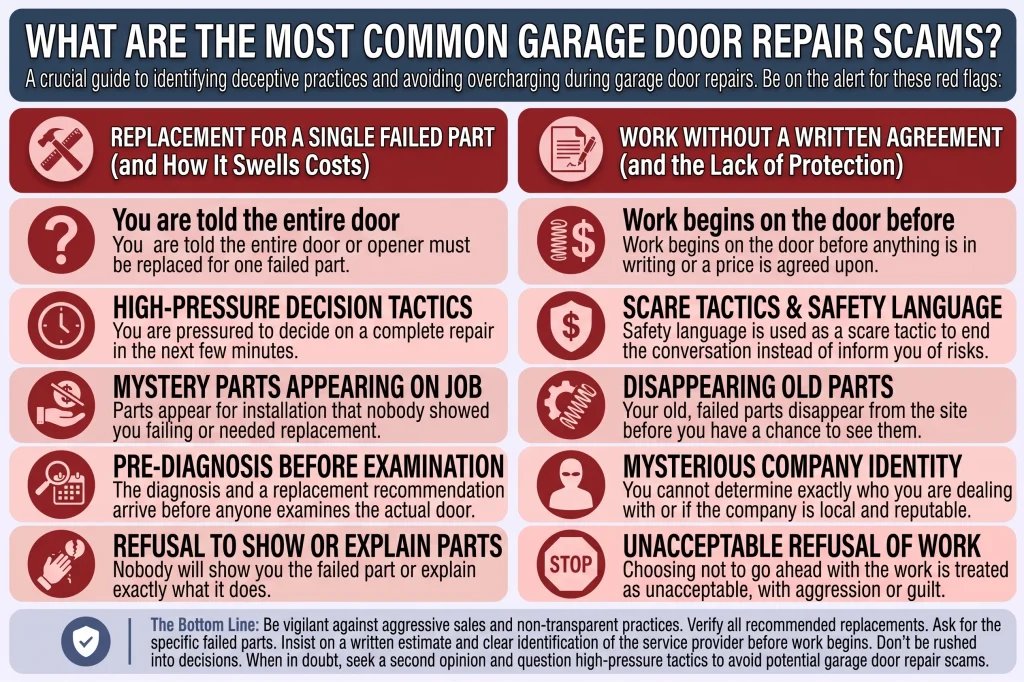
1. You are told the entire door or opener must be replaced for one failed part
This is the most common overreach, and it is the one with the largest consequences. A garage door is a system of independent parts. A cracked bottom panel, a broken cable, a failed roller, or a snapped spring is a component failure, not a system failure. Replacing the whole assembly because one piece of it broke is like replacing a car because it has a flat tire.
The tell is the jump in scale. The symptom you called about is small and specific (a noise, a sag, a door that stopped part way), and the recommendation that comes back covers everything. When you ask why the rest has to go, the answer stays general: it is old, it is all worn out, it will fail soon anyway.
How to tell if your garage door really needs to be replaced or just repaired
Ask one question: which specific part failed, and what happens if only that part is addressed? A real answer names a component and describes a consequence. A vague answer means the diagnosis is not the reason for the recommendation.
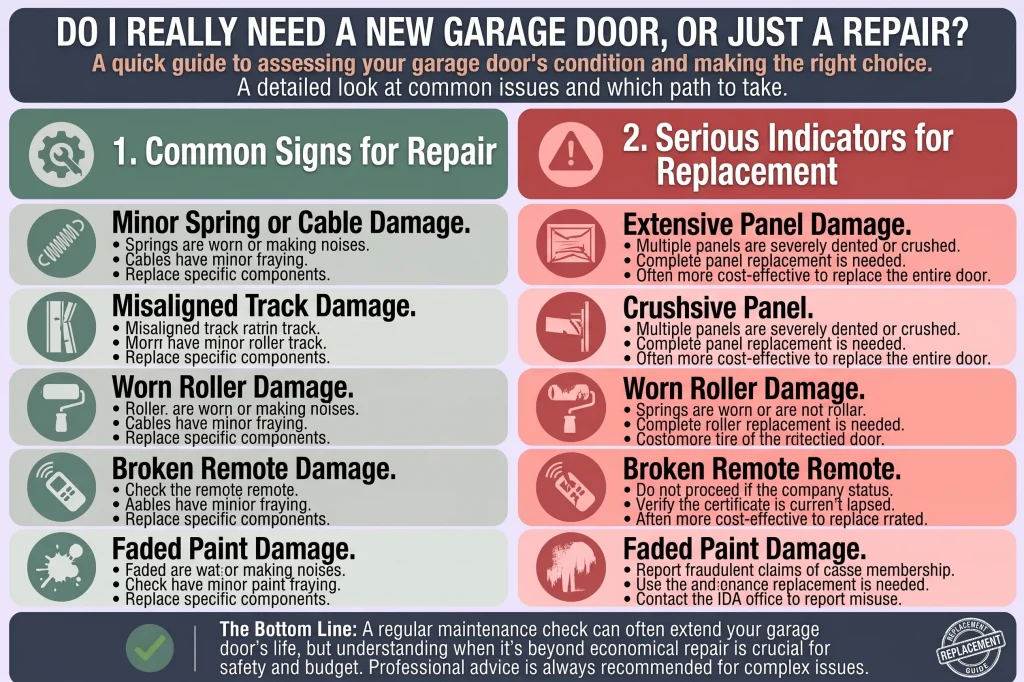
Then check the door against the actual reasons a full garage door replacement makes sense: widespread panel damage across multiple sections, a frame that is no longer square, or repeated failures in different systems within a short window. One broken component on an otherwise straight, quiet door is not on that list. Our own guides on early signs of garage door panel problems and whether full panel replacement is necessary go deeper on where that line sits, and the signs that genuinely point to replacing an older door covers the legitimate cases.
The same logic applies to openers. A unit that will not respond is usually a power, remote, or sensor issue before it is a dead motor, and a garage door opener that has been running fine for years does not normally die in the same week your remote stopped working.
For a fuller breakdown of this specific pattern, read Do I Really Need a New Garage Door, or Just a Repair? 6 Signs You’re Being Pushed Into a Replacement.
Stop and get a second look if: the recommendation covers parts you never reported a problem with, or nobody can tell you what happens if only the broken part is handled.
2. You are pressured to decide in the next few minutes
Real urgency exists in this trade. A door hanging crooked in the opening, a broken spring holding a door up, a door stuck open on a house nobody is home to watch: those are same-day situations, and any technician will tell you so plainly and then let you decide.
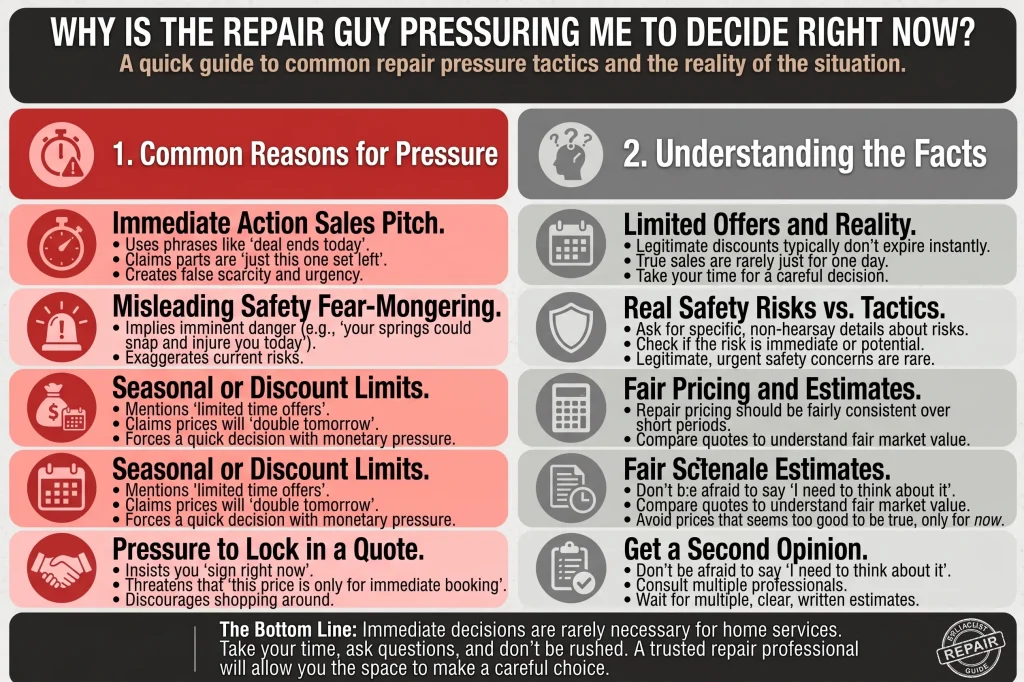
Manufactured urgency sounds different. It attaches a deadline to your decision rather than to the door’s condition. The crew is only in your area today. The part is the last one on the truck. The situation gets worse the longer you wait, with no explanation of how. The deadline is always about the person selling, not about the door.
Why garage door repair companies pressure you to decide right now
Because a decision made in three minutes is a decision made without a second opinion. That is the entire mechanism. Every minute you take is a minute you might use to call somebody else, which is why the pressure exists in the first place.
Slowing down takes almost nothing from you. If the door is genuinely unsafe, secure the opening and leave it closed until it is addressed. If it is not, take the evening. A company that cannot survive you thinking overnight has told you something useful about itself.
The behaviors behind this are covered in Why Is the Repair Guy Pressuring Me to Decide Right Now? 6 High-Pressure Tactics and What They Actually Mean.
Stop and get a second look if: the deadline is about the visit rather than the door, or if asking for a day is treated as a problem.
3. Parts appear on the job that nobody showed you failing
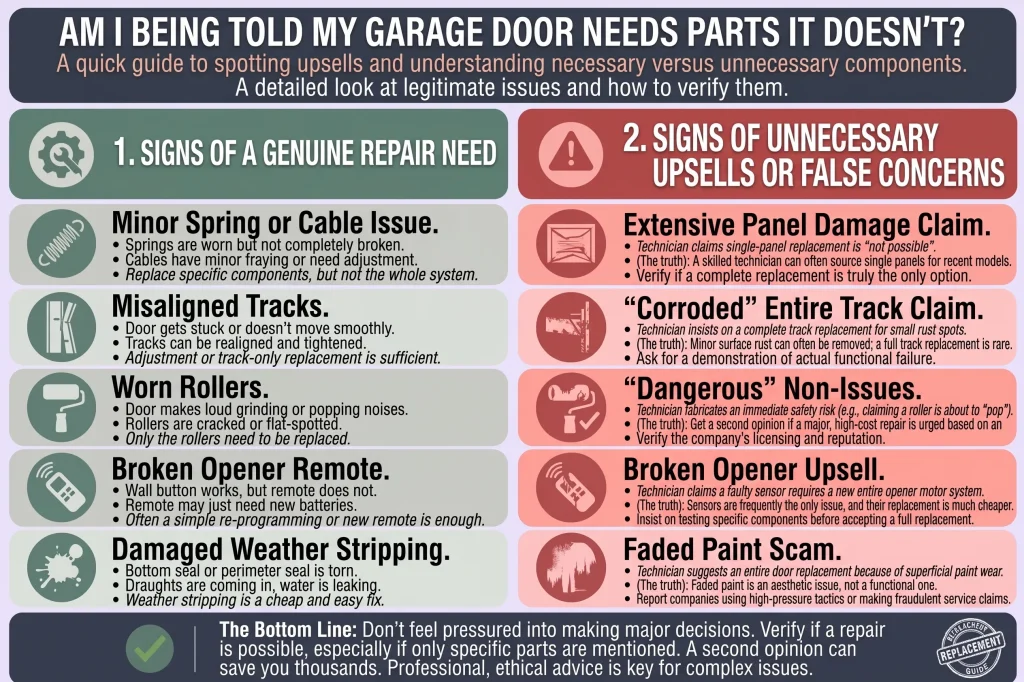
You called about one thing. By the time the work is described, the list has grown: rollers, hinges, bearings, cables, brackets, a bottom seal. Some of that may be real. Wear does cluster, and parts that ran together for fifteen years often reach the end together. But every item on that list should come with a demonstration, not just a mention.
The pattern to watch is additive rather than diagnostic. Parts get added to the list without anything new being found, and each addition is justified by age rather than by condition.
How to tell if a garage door part actually needs replacing
Ask to be walked to each part and shown the specific condition being described. Worn rollers have visible flat spots or play in the stem. Frayed cables show broken strands. A bad bearing is audible when the shaft turns. A failed torsion spring repair case shows a clean gap in the coil that you can see from the floor without touching anything.
That last one matters, because springs are the part most often invoked and least often checked by the homeowner. Our guide on how to know when a torsion spring is broken shows what the failure actually looks like, and whether a worn spring can break suddenly covers the honest version of the “it could go any day” claim.
Noise is the other soft entry point. A loud door is usually a maintenance or alignment condition rather than a failure, which is why what causes a garage door to make noise is one of the more useful things to read before anyone gives you a parts list. Alignment sits in the same category: some doors that seem to be failing are simply out of adjustment, which how to adjust a garage door explains.
The full version of this pattern is in Am I Being Told My Garage Door Needs Parts It Doesn’t? 7 Unnecessary Part Replacements Homeowners Get Sold.
Stop and get a second look if: you cannot be shown the condition on any part on the list, or the justification for each addition is only its age.
4. The diagnosis arrives before anyone examines the door
Sometimes you hear the conclusion on the phone, before anyone has seen the door. Sometimes it arrives within a minute of the technician walking in, delivered while the door is still closed. Either way, the sequence is backwards.
A garage door diagnosis requires the door to be run. It has to be opened and closed, watched through its travel, listened to, and disconnected from the opener so the balance can be felt by hand. That takes several minutes at minimum. Nobody can compress it into a glance from the driveway.
Why a garage door diagnosis over the phone is not a real diagnosis
A phone call can narrow things down. It cannot confirm which part failed, and any honest conversation will say so. When a specific part and a specific scope of work are named before anyone has seen the door, the diagnosis was decided in advance and the visit is there to deliver it.
Watch what actually happens during the visit. Did the door get cycled? Did anyone look at the springs above the opening, the cables at the bottom brackets, the track for bends, the sensors near the floor? A technician who never touched the door and never ran it has not diagnosed anything.
Stop and get a second look if: the scope of work was fixed before arrival, or the door was never cycled during the visit.
5. Nobody will show you the failed part or explain what it does
Every part on a garage door has a job that can be explained in one sentence. Cables carry the door’s weight. Springs counterbalance it. Rollers guide it in the track. Sensors stop it from closing on something. If a part failed, the person who found it can point at it and tell you what it was doing.
Refusal to do that is a strong signal. So is deflection: the subject changes, the explanation turns to jargon, or you are told it is too dangerous for you to be near. Standing several feet back and looking at a spring is not dangerous. Being told you cannot look at it is a different thing.
Why a garage door technician should show you the broken part
Because it is the only verification available to you. You cannot audit the diagnosis after the fact if the evidence left in the truck. Seeing the failure with your own eyes turns an unverifiable claim into a fact, which is exactly why it gets avoided when the claim is not real.
Ask early, before any work starts, and ask plainly: can you show me? In our experience across the Celina and Prosper area, that single question ends more questionable visits than anything else a homeowner can do.
Stop and get a second look if: you are told you cannot look at the part, or the explanation of what the part does never arrives.
6. Work begins before anything is in writing
Before a wrench comes out, you should have a written scope of work in plain language: which part failed, what will be done about it, and what is being left alone. Not a verbal summary. Not a note that says “garage door service.”
Verbal-only arrangements are the environment where scope grows. Work that was never described becomes work that was always necessary, and there is no document to compare it against afterward.
Why you should get the garage door repair scope in writing first
Because the written scope is the only fixed point in the whole visit. Everything else is memory, and memory loses to confidence. Once the specific part and the specific work are written down, additions have to be explained rather than assumed.
Keep it simple. The named part, the work to be done, and the date. If a company will not produce that before starting, the reason is rarely paperwork.
Stop and get a second look if: work starts with nothing written, or the written description is too general to name a part.
7. Safety language is used to end the conversation instead of inform you
Garage doors deserve genuine respect. They are the heaviest moving object in most homes, springs hold serious stored energy, and there are real reasons a homeowner should not put hands on certain components. Those facts are why safety language works so well as a pressure tool.
The distinction is what the warning is doing. A real safety warning gives you information and leaves the decision with you: here is the specific hazard, here is what not to touch, here is the consequence. A manufactured one is used to make questions feel irresponsible. It is broad, dramatic, and always arrives right when you start asking why.
How to tell a real garage door safety warning from a scare tactic
Real warnings are specific and they name a mechanism. Vague catastrophe is not a diagnosis. If you ask what exactly is unsafe and the answer stays at the level of the whole door, the warning is doing sales work rather than safety work.
You can read the honest version of this for yourself. Our breakdown of the safety hazards genuinely linked to garage door repair covers what the actual risks are, which makes it much easier to recognize when the topic is being used as a lever. The door industry’s own association also maintains a public resource on repair scam awareness that describes the same pattern, and it has publicly flagged rising scam activity across the garage door trade.
Stop and get a second look if: the safety claim never gets specific, or it appears only after you start asking questions.
8. Old parts disappear before you can see them
Removed parts belong to you. Under normal practice, they come off the door and go somewhere visible, and you are welcome to look at them or keep them. It is a routine, unremarkable part of the job.
When old parts vanish quickly, get bagged and loaded before you have looked, or are described as already gone when you ask, the verification you were owed is gone too. This one is especially worth watching because it is the check you can run after the fact, when you have had time to think and the pressure of the visit has lifted.
Why you should keep your old garage door parts after a repair
Because a part in your hand either shows the failure you were told about or it does not. A spring that was replaced for being broken has a visible break. A roller replaced for wear has worn surfaces. A cable replaced for fraying has frayed strands. If the removed part looks serviceable, you have learned something concrete that no conversation could have told you.
Say up front that you would like the old parts. It is a normal request, and how someone reacts to it is informative on its own.
Stop and get a second look if: removed parts are gone before you can look at them, or the request to keep them is discouraged.
9. You cannot tell who you are actually dealing with
You called one name. The vehicle in your driveway carries a different one, or none at all. The person at the door does not offer a company name, and the paperwork, if it exists, is generic. Ask which company they work for and the answer is a first name and a phone number.
This matters for a plain reason: accountability requires a name. If something is wrong next week, you need a company to call, and a nameless visit gives you nobody to call. It is also the sign that most often accompanies the others on this list.
How to confirm which garage door company is actually coming to your home
Confirm before the visit rather than during it. When you book, get the company name and note it, and when someone arrives, ask them to confirm the same name and the appointment. Consistency between the two is a low bar, and it is a bar that most questionable operations do not clear.
Our guide on how to choose the right garage door repair company walks through what to establish before anyone is scheduled, which is a much better time to sort this out than at your open garage. Manufacturer resources cover the same ground: there is a manufacturer buying guide on avoiding garage door scams that homeowners find useful for exactly this step.
Stop and get a second look if: the company name you booked and the name that shows up do not match, or nobody will give you a company name at all.
10. Declining the work is treated as unacceptable
The last sign shows up only when you use the word no. It is also the clearest.
A legitimate visit ends when you end it. You may decline, ask for time, or say you want another opinion, and the response is straightforward: the door is left as safe as it can be, and the visit is over. There may be disagreement, and that is fine. There is no argument about whether you are allowed to decide.
When declining triggers escalation, repeated attempts, guilt, or a technician who simply does not leave, the interaction has stopped being a service call. Whatever the diagnosis was, this is now the more urgent issue.
What to do when a garage door technician will not accept no
Say it once, clearly, and stop explaining. Repeated justification invites more negotiation. If the door has been opened or partially disassembled, ask for it to be left secured and closed. If someone will not leave your property, you are entitled to treat that as what it is and involve local authorities.
Then get a second opinion at your own pace. If the diagnosis was real, the next company will find the same failure and tell you the same thing. That outcome takes one phone call. The alternative can mean agreeing to an entire garage door installation or a torsion spring replacement you never needed.
Stop and get a second look if: no is met with pressure rather than acceptance. At that point, end the visit.
Normal practice vs. red flag: a side-by-side check
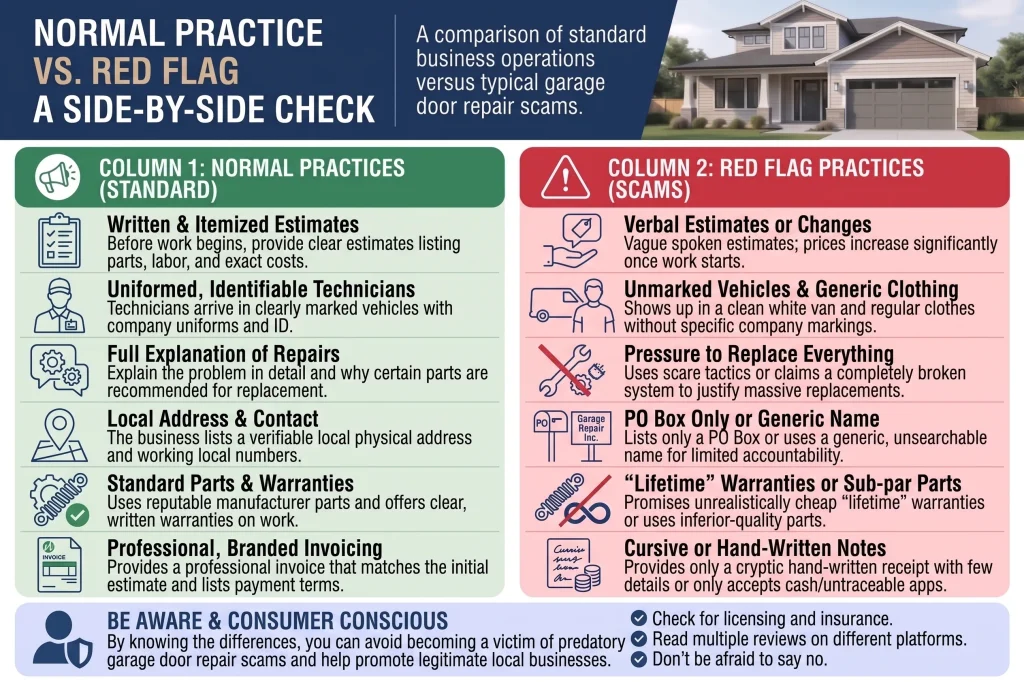
| What is happening | Normal practice | Red flag |
| Diagnosis | Door is cycled, watched, and checked by hand before anything is named | Conclusion given on the phone or from the driveway |
| Scale of the work | One named part is addressed; the rest is left alone | Whole door or opener replacement for a single failure |
| Timing | You are told plainly whether it is same-day, then left to decide | Deadline attached to the visit rather than the door’s condition |
| Evidence | You are walked to the failed part and shown the condition | You are told you cannot look, or the subject changes |
| Parts list | Each item is demonstrated before it goes on the list | Items added by age alone, with nothing new found |
| Documentation | Written scope naming the part and the work, before starting | Verbal only, or a description too vague to name a part |
| Safety talk | Specific hazard, specific mechanism, decision left with you | Broad catastrophe, arriving right after you ask questions |
| Old parts | Left visible, yours to keep | Removed and gone before you can see them |
| Identity | Company name matches what you booked | No name given, or a different name than you called |
| Saying no | Visit ends, door left secured | Escalation, repeat attempts, or refusal to leave |
The short version
Almost every one of these signs is a variation on the same theme: verification is being removed. You cannot see the part, cannot read the scope, cannot keep the evidence, cannot take a day, cannot get a second opinion. Each individual step sounds reasonable in the moment. Together they leave you agreeing to something you were never able to check.
The correction is not technical knowledge. It is three sentences. Show me the part. Put it in writing. I will decide tomorrow. A visit that survives all three is almost certainly a real one. A visit that resists any of them has told you what you needed to know.
Alliance Overhead Door has run service calls across Celina, McKinney, Aubrey, and the surrounding communities, including plenty of calls that turned out to be second opinions on somebody else’s diagnosis. If you have been told your door needs more than it seems like it should, or you want a straight answer on what actually failed, schedule a visit or send us the details of what you were told and we will tell you what we find. Same-day availability is usually possible, and if your door does not need what you were told it needs, that is what you will hear.
Frequently asked questions
2. Is it normal for a technician to diagnose my door over the phone?
Narrowing it down over the phone is normal, and we do it on most calls, because the symptom tells us what to bring. Naming the exact failed part and the exact work before anyone has seen the door is not normal. If a specific part is confirmed sight unseen, ask how that was determined.
3. What if the technician will not show me the broken part?
Treat that as the moment to pause. Our rule of thumb from the field is that anything we can diagnose, we can point at. There are parts a homeowner should not touch, but there is no part you cannot stand back and look at. Refusal to show you is not a safety practice.
4. My door only acts up some days. Could that be used to sell me something I don't need?
Intermittent faults are the easiest thing in this trade to oversell, because the door often behaves normally while somebody is standing there. That does not mean nothing is wrong. It means the diagnosis has to identify a mechanism, not just replace parts until the symptom stops. Sensors, remotes, and loose connections are common intermittent causes, and they are quick to check.
5. My remote only works when I am very close to the door. Do I need a new opener?
That is one of our most common calls and it is almost never the opener. Weak range usually traces to a dying remote battery, a nearby electronic device creating interference, or an antenna wire on the unit that has been bent or tucked up. Range loss on its own is not a reason to replace a working unit.
6. How long should I take to decide on a repair?
As long as you want, with one exception: if the door is off track, hanging unevenly, or stuck open on an unoccupied house, secure it and address it promptly. Everything else can wait a day. In our experience, nobody has ever regretted taking an evening to think, and the visits that cannot tolerate an evening are the ones worth thinking about.
7. Is it rude to ask a technician to leave?
No, and you should not feel awkward about it. It is your home and your decision. Say it once and clearly. Anyone who takes it personally is telling you something about how they work.
8. Should I have a second company look at the same problem?
Yes, and it is one of the most useful things a homeowner can do when something feels off. A real failure gets found twice. When two independent visits describe the same part and the same work, you can stop worrying. When they describe completely different problems, you have learned something important.
9. I already had work done that I now think was unnecessary. Is there anything I can do?
Start by finding whatever documentation you have and the old parts if you kept them. Then have someone look at what was actually installed and whether it matches what you were told. Even when there is no undoing it, knowing what really happened matters, and it tells you what to watch on the door going forward.
10. How do I know if a same-day repair is genuinely urgent?
Urgency comes from the door's condition, not from the schedule. A door that will not close on an unattended house, one hanging crooked in the opening, or one with a visibly broken counterbalance holding weight overhead: those are same-day. A noisy door, a slow door, or a cosmetic dent is not. If someone says urgent, ask what specifically happens if you wait until tomorrow. A real answer names a consequence.